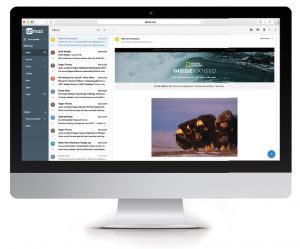





Celebrating 10 Years

December 8, 2008

This month, we celebrate the ten years since Ben Duncan’s creation of a webmail interface - one that has evolved into AtMail.

AtMail, much like the people who have been involved in it, has grown. It has taken leaps and bounds in line with our passion, our desire to create. AtMail has branched into several iterations suiting different needs of different groups of people. Forks have spawned, each one for a specific requirement, and each one growing into a wholly different product.

And so we take a look back:

1998
- Ben Duncan begins coding a new webmail interface in Nova Scotia during Dec 1998

1999
- Atmail launches into the marketplace as one of the first commercial Webmail clients available. Astounded by the demand for Atmail, first operations are run from Amsterdam, The Netherlands while Ben worked for an Internet startup company.

2000
- Funded by a large Xerox deal, Ben and friends decide to take Atmail onto the road. They purchase a 4×4 and kit to travel around the coast and outback of Australia for 10 months, while developing and supporting Atmail. When the 9600 baud GSM modem was out of coverage, the team would resort to using an accoustic coupler to commit code changes.

No kidding:

2001
- AtMail is offered at a very low price. It is a webmail interface that can integrate with the 4 major MTAs (Sendmail, Qmail, Postfix, and Exim).
- Corey Bissaillon joins the team.

2002
- An office in Sydney, Australia is acquired.
- The demand for AtMail rises. AtMail customers are using the webmail interface to provide access to corporate, educational, and government email systems.

2003
- AtMail 3.5 is released. Created using the Perl language, it is available in both the Linux and Windows operating systems.
- Andy Grayndler joins the team.

2004
- AtMail 4.0 is released. Boasting vast interface improvements, it is a significant step from the previous major release - aesthetically and functionally.
- Exim,ClamAV and SpamAssassin are adopted as solid components of the AtMail system.
- John Contad joins the team.

2005
- The AtMail 4.1 branch is created.
- Localization improvements are added, allowing people to tailor AtMail for different languages.
- Outlook Synchronization utilities, along with other applications for Microsoft Windows® are put into place.
- Jason Brown joins the team.

2006
- The AtMail Appliance is released. With its plug-and-play capabilities, client adoption for @Mail soars.
- The AtMail 4.6 branch is released, with extensive AJAX support and interface improvements.
- The videomail component of AtMail is created.
- Brad Kowalczyk joins the team.
- Idaho office acquired.

2007
- AtMail 5.0 is released. PHP is adopted as the development language.
- With the new version and large number of improvements, adoption once again rises. Numerous universities, government branches, and ISPs now use AtMail.
- Partnerships are forged with SWSoft/Parallels and Verio.com.
- Stewart Bazley joins the team.

2008
- With the new language and a bigger talent pool, the development for AtMail blitzes to its fastest. Upgrades are issued to customers on a monthly basis.
- AtMail Open, the free version of AtMail, is released.
- AtMail Cluster Edition is released.
- Development R&D centre acquired in Peregian Beach, Australia.
- Allan Wrethman, Ben Ferguson, Mikaela Duncan and Luke Stephens join the team.
- Largest growth and profit to date - Over 4,000 clients and 15M+ end user accounts.

It has been quite a journey for us here at AtMail. But while we have accomplished so much so far, this is modest compared to what we plan, and are looking forward to do. Abundant opportunities, changes and improvements lie ahead.

Stay tuned.


Filed under: Frontpage, Open Source — John Contad @ 6:15 pm

2 Comments »

  1. Well done Ben and team. You should be very proud of this great Australian Export. A good product and great management has seen @Mail through economic booms and busts.

    Looking forward to seeing you grow over another 10 years.

    Comment by Declan Ingram — December 8, 2008 @ 8:59 pm
  2. Congratulations!

    Comment by Tomas J Stehlik — December 9, 2008 @ 11:19 am

RSS feed for comments on this post. TrackBack URI

Leave a comment